
Showing posts with label cold frames. Show all posts
Showing posts with label cold frames. Show all posts
Saturday, January 1, 2011
New Year's Day
I cleaned the snow off the cold frames yesterday (New Year's Eve) because we are having a warm spell (around 50 degrees). I took the covers off today so that the rain could reach the plants and then covered them at sunset (which is currently 4:36). There hasn't been any noticeable growth, which is not surprising considering that the glass has been covered with snow for at least three weeks. I was a little surprised that the mache plants hadn't grown at all because they are supposed to grow through the winter - but apparently that requires more light than passes through several feet of snow.
Yesterday was a sunny day. The soil temperature was around 45 degrees in each of the cold frames that I tested.
It will get cold again tomorrow, although the day time highs will be around freezing for the next few days. I plan to put the foam covers on the two frames that have them and will remove the covers if it is to be a sunny day. If it snows I will probably let the other two frames be covered with snow. The fifth frame, where I have always planted lettuce, remains covered with snow since I know that the lettuce isn't going to grow until March and it is not large enough to pick. I am hoping to pick a little kale from the frames sometime this winter. The kale plants look good.
The only plants that look like they haven't survived are some small arugula transplants. I don't think they were large enough, but who knows if they are just sitting there waiting for better conditions.
Indoors, we had our second picking of lettuce from the plants in the cellar. This time I only harvested leaves from one of the original three trays and got just a little over three ounces, about the same as I picked from all three trays earlier.

Thursday, December 16, 2010
The End and the Beginning
 We have reached two boundaries. One is the end of outdoor produce and beginning to grow a little of something indoors. The other is beginning to draw down what is in storage.
One example of using what is in storage is the potato-pepper-onion meal. The potatoes and peppers are from the garden. I stored the potatoes in the cellar, but noticed that they are beginning to sprout. That means that they will begin turning soft fairly soon. The peppers were blanched and frozen when we had more than we could eat. The onions would have been scallions from the garden, but with some 40 inches of snow they weren't available.
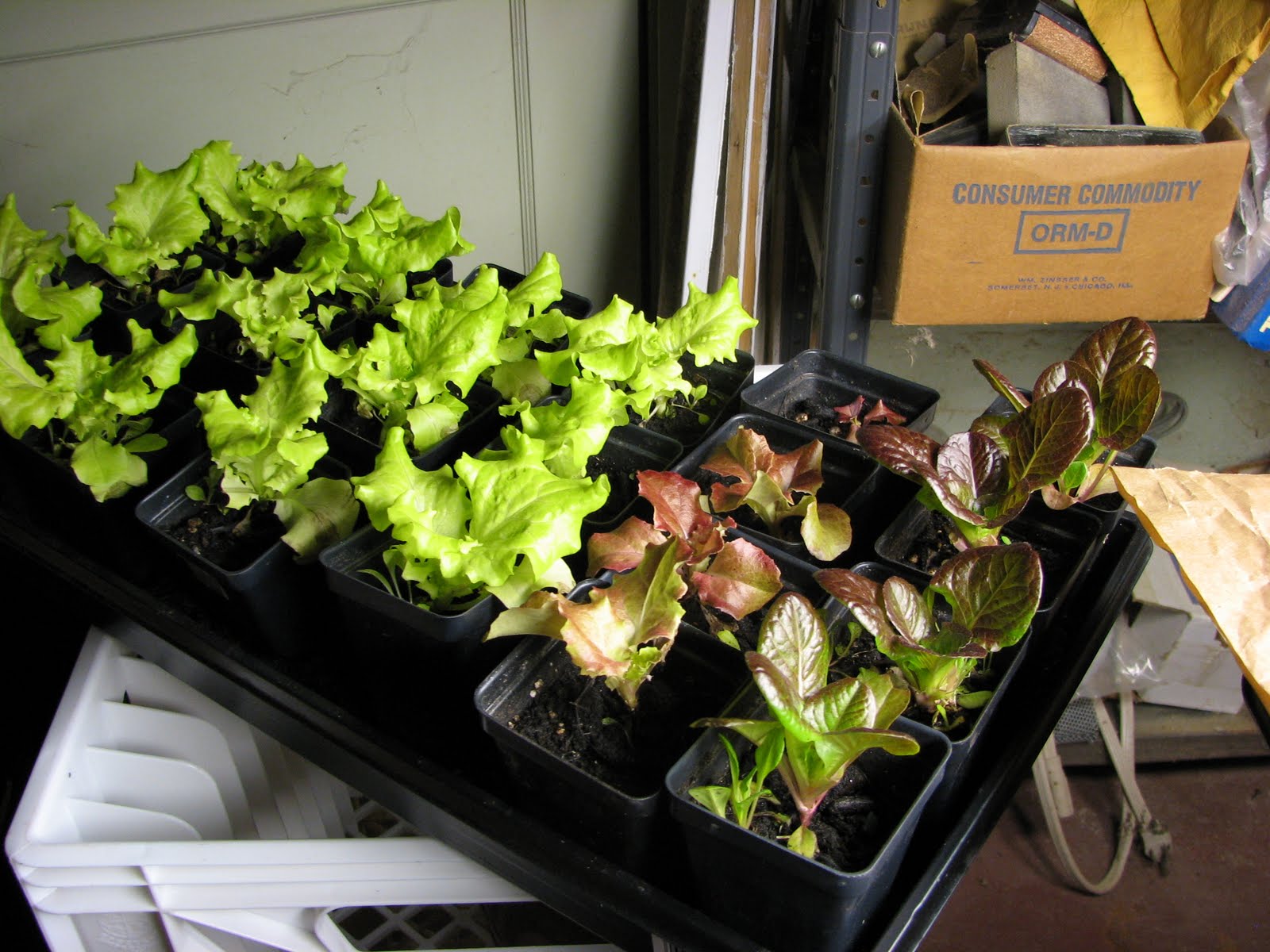 As for trying to grow something, one experiment this year is to grow some lettuce under lights in the cellar. I currently have four trays under two fluorescent fixtures. I harvested a grand total of slightly less than three ounces of little leaves last week. I expected the lettuces would grow larger (and perhaps they will) but since they have a fairly deep root and are in little pots I now think this experiment fail to produce enough to justify the time and electricity (about one kWh per day). I did later add some potting soil to the bottom of the tray so that the roots that have grown out of the bottom of the pots have a place to expand. But I think the real answer would be to plant the lettuce in much deeper containers and that means more potting soil and fewer plants in the same space.
The other source of produce from the garden in the winter is what is in the cold frames outside (kale, mache, claytonia and lettuce). I haven't seen what is happening out there for over two weeks because of the snow. But that provides an opportunity to see what happens when the cold frames remain covered with snow for a long time.
Sunday, April 4, 2010
The Early Spring Garden
 Global warming brought us some very warm early April days. The high was 87 degrees yesterday. Today was a little cooler but very sunny and comfortable. In short, great weather to be in the garden.
Typically there wouldn't be much in the garden at this time of the year. But with the new cold frames we are nearly ready to begin eating. The lettuces in this photo are the ones that I started last October and which were in my old glass covered frame during the winter. The frame is now behind the lettuce and is covered with row cover material. The frame contains Chinese cabbage, pak choi and komatsuna (another Asian green) that I had started indoors on February 11th and that I transplanted out fiv
 e or six days ago. Initially the row cover material was to protect the transplants from the sun since they were hardened off only for a couple of days. But my Asian greens have often been a food source for flea beetles and so the row cover now keeps off any flea beetles. [I don't know if they would be around this early in the year.]
In one of the new cold frames I transplanted lettuce, spinach, and zen around four weeks ago. This frame is not insulated and doesn't retain as much heat as my other two new ones. One of them is pictured below.
 This frame, which is insulated (the insulation is covered with black plastic to protect it and presumably absorb more heat), contains some red lettuce in the lower corner, then a group of mache (corn salad), some spinach at the top which is mostly overgrown with zen (the larger leafed plants). If you could see closer up you would see from the holes that zen is a favorite of the slugs. So far it seems that the slugs concentrate on the zen and the Chinese cabbage and pretty much leave alone the Claytonia (which is in the one cold frame not shown here), the mache, spinach and lettuce.
The red object in this photo and the black object in the photo above it are the plastic covered pieces of board that I use to attract slugs. My wife suggests that if I got up earlier in the morning I could go out and pick the slugs off the plants before they scatter to avoid the sun. She got about a dozen this morning which is more than I typically find under the boards. Where do they all come from? Since I am more of a night person maybe I should go out at night with a flashlight and pick off the slugs before they can start eating.
Having the claytonia, mache, lettuce, spinach, and Asian greens available is a result of using the cold frames. But this year we had another surprise. In the fall I planted a lot of Red Russian kale. It had been so productive for us during the year that I started some late in the season and planted them in a number of places. Then winter came before they were big enough to provide anything for us to eat. I have read that Red Russian kale is not the best variety to try and maintain through the winter and so I assumed that they would end up as a cover crop. When the heavy snow that we had in late February/early March finally melted away there were the kale plants. And here is what they look like now. They are definitely growing and I would not be surprised, depending on the weather, if we have some to eat very soon.

Saturday, March 6, 2010
Extending the Season
It should be obvious that one of my main projects this winter has been preparing to grow vegetables for a longer part of the year. That is the reason for the various cold frames that I have been making.
It is becoming clear to me that these frames should have been in place last fall and that the way to extend the season for greens (and carrots and whatever other vegetables we can nurse through the winter) is to have them set out and planted before the cold weather begins. I have read that mache will continue to grow through the winter. But most other vegetables would either need to be fully grown before the winter comes full force and picked as needed through the cold weather or at least established and allowed to just sit in the cold frame under the snow ready to start growing as soon as the weathe
 r warms.
One thing I did was to sow some spinach seeds in November and I believe they have germinated and are waiting to begin growing. They were in the "lettuce frame" from which I just cleared off the snow today. (There is the photo of the beginning of the process.) In a day or two I will see if they are growing or not.
There are two upcoming presentations about extending the season. On Saturday, April 24th, the Edible Gardening CNY group will hear Jennifer Cleary talk about that subject at the Liverpool Library (Liverpool, NY) at 2:00 P.M. That is free and open to the public. If you need more information contact me at john.allen1@verizon.net. Then, on April 27th the Finger Lakes Permaculture group will present their Community Food Growing Series: Season Extension from 4:30 to 6:00 P.M. at the Ithaca Children's Garden at Cass Park, Route 89, Ithaca, NY. Pre-registration is required. Contact Josh Dolan at sapsquatch7@gmail.com or call 607-272-2292. Cost $5.
If you are interested in extending the vegetable growing season I would be very pleased to hear from you.
Wednesday, March 3, 2010
Out In the Snow
Spring is not coming fast enough. I have more seedlings in my cellar than I have places to plant them.
Right now the garden has four glass covered frames in it. The oldest is what I call the "lettuce frame" and I have used it for a number of years to overwinter lettuce seedlings so that they are ready to take off as soon as the weather warms enough to melt off any snow and then provide light for the lettuce plants to start growing again. With the recent 18-24 inches of snow that hasn't happened yet. I did brush the snow off before that downfall and found that the soil was still frozen.
Then there is the green cold frame that was the subject of an earlier post. That one is filled with mostly mache and claytonia. The plants have survived and I expect will soon start growing visibly. I have begun removing the insulation cover from 8 A.M. until 6 P.M. so that the plants get at least ten hours of light. The air temperature inside the frame yesterday afternoon was about 76 degrees an
 d the soil temperature about 56 degrees. Today I propped the glass open a little so that it wouldn't get too hot.
The third frame, pictured here, is a clay colored cold frame that is much larger than the green one. It is currently filled with spinach, lettuce, mache and zen (a mild green). In this photo it is propped open so that it doesn't overheat on this 42 degree sunny day.
The fourth frame is my simplest one. I made it from cedar fence slats from the 20 year old fencing around the yard that was replaced several years ago. [I kept a lot of them.] Although the surface of the boards look as if they are rotting, when I cut them I found a lot of solid wood inside. Because this was made from cedar I didn't have to prime or paint. I also did not insulate this one at all and do not plan to make an insulated cover for the glass. So this will be used somewhat differently than the other two. It does have the advantage that I have two screens from the same window that the glass came from and I will be able to remove the glass and use the screens in early spring to protect seedlings
 from insects such as flea beetles. This frame was set down on about a foot of heavy snow two days ago. Today I took off the glass covers and removed as much snow as I could and pushed the frame down onto the garden surface. The forecast is for sun during the next five days and by the end of that time the snow will be gone and the soil warm enough for planting. Or so I hope because I have those seedlings to plant out. I think I have far more than will fit into that frame. It may be time to start the next cold frame. I do have a lot of fence slats that I have been saving for something.
This photo was taken a couple days after writing this. I am digging as much of the soil in the frame as is diggable. Around the edges the soil is still frozen and comes up in cold lumps, if at all.
Saturday, February 6, 2010
First Produce of the Year

It is a very small start, but yesterday we ate our first produce of the new year. It consisted of a little spinach, a few cutting celery leaves, and a little claytonia. It wasn't enough to justify weighing and none of this came from the outside garden. This is Syracuse in February.
The spinach came from seeds that I started indoors in late December to plant into the outside cold frames. The cutting celery and claytonia were started earlier in December as an experiment to see if they would grow. I had tried both of those and mache (corn salad) seeded directly to the garden last year with no success. But they germinated quite well and some were planted into the cold frame on January 22nd and are still sitting there looking a little worse than when planted.
I have finished and set out a second (and larger) cold frame. The soil inside is mostly unfrozen although around the edges it is still pretty solid. I am planning to plant some spinach, leek, and Asian greens tomorrow, if it is sunny. The temperatures are not forecast to go above freezing for the next week and it will be interesting to see how quickly the seeds germinate or if they do. I have been recording the soil and air temperatures inside the first cold frame. The soil temperature, at about three inches deep, has remained above freezing although the outside temperature has been as low as -8 degrees Fahrenheit. In the late afternoon the soil temperature has been in the 40s and the high temperature inside the frame has reached over 80 degrees on two sunny days.
I hadn't planned to extend the season at this end of the season this year but since two cold frames are done there is no point having them just sit around waiting for October. I should learn something that will help next winter.
Subscribe to:
Posts (Atom)