Monday, August 26, 2013

Straw Bale Update

Strawbales August 26th
The six nice firm straw bales that were set out on the driveway at the beginning of the season are breaking down. On the left of the photo the tomato plants are tilting and the bale is about half of its original height.

Production by the tomato plants in the bales has been significantly less than the same seven plants that are in the regular garden. Although these plants produced the first tomatoes the difference in time was only a few days. When I was keeping track of the individual plants the straw bale plants produced about half of what the garden bed plants did. And after that the difference increased. The plants that produce the larger tomatoes (brandywine, Hungarian heart, jetstar and Polish linguisa) were far less productive than those in the garden bed.

Location might have been a factor, these plants being on the shady side of three arborvitae, but it is more likely that lack of nutrients and inability of the straw to retain moisture the way that soil does were bigger factors. The plants were watered daily and were provided with green sand, bone meal and blood meal mixed with compost but that wasn't sufficient.

The squash plant did fairly well and kept up with the squash plant in the garden for quite a while. The first squash were picked from the bales on July 4th and the first from the garden on July 16th. As of August 10th, when I stopped keeping track of where squash came from, the plant in the bales had produced 10.7 lbs and the plant in the garden 10.2 lbs. Then there was a five day period in which it was watered only once and production dropped after that.

One problem with the bales is that water tends to run to where the edges of the bales meet and, over time, enlarge the gap between the bales. I tried to counter this by planting in the middle of the bales.

It will be interesting to see how much structure is left in the bales at the end of the season.

Sunday, August 25, 2013

Suggestions for Next Year

I am not always thinking ahead. I continue to plant too close together, I sometimes plant too much or too little of something, and I frequently see ways that I might do things differently. Included in those categories this year are:

1. Plant peppers with space between the rows. Last year I just planted the peppers too close together. I improved this year and put more space between them. But they are still too close together, such that the ones in the middle seem not to produce very much. I think that in the space where I had 34 pepper plants I could plant 24 with more space around each plant and get similar quantities of peppers. I will still plant them about 12 inches apart but with about 24 inches between rows. I also have longer stakes for the peppers but only used a few of them this year because I already had them tied to the wooden stakes.

2. Don't plant so many tomatoes. This year, because of the straw bale experiment, I planted nearly twice as many tomatoes as I would otherwise. I ended up planting 17 plants, as opposed to 6 last year. (Six is not enough.) I think about ten plants would be sufficient. I will not plant the Ida Gold and Glacier tomatoes again. They are both determinate plants and have small tomatoes. The Ida Gold had very tough skins and the Glacier tended to crack. Instead I will plant one early tomato (such as Fourth of July).  I also need to find a way to support the large yellow determinate tomatoes. They produce well but I put them in tomato cages which do not provide enough support and many of them ended up on the ground. The Polish linguisa and Hungarian heart tomatoes are good varieties. Not sure about the Jetstar or Brandywine.

3. Plant fewer cucumbers and have the poona kheeras grow up a slanted trellis. Perhaps then the cucumbers will hang down under the trellis. The lemon cucumbers grow throughout the garden, which is a problem because they invade the space of other plants. One solution may be to plant them in the blueberry area, but this requires having the blueberry harvest done before the cucumbers have grown very much. We prefer the lemon cucumbers.
The use of kaolin clay seemed helpful. It appears that some of the cucumbers were infected because they have wilted. Others, however, were apparently not affected. It may be that some were effectively sprayed while the others weren't. The cucumbers near the trellis were planted there from seed and sprayed as they grew but they were only sprayed twice and their location made it difficult to do so effectively. Some that I started inside and sprayed thoroughly and planted elsewhere in the garden seem to be fine. Cucumber beetles have been present throughout the gardening season.
Spraying the patty pan squash plants was effective for both plants, and the production has been excellent (sometimes a little more than we can handle).

4. Prune the grapes. We have far more grape clusters than the two plants can handle. The grapes are small and it remains to be seen how many will ripen. I pruned the grapes in March. I pruned again later but there were still way too many. I assume that if I prune properly, so that there are perhaps 40 to 50 clusters, the grapes will be larger and the clusters filled in. This will take some serious and thoughtful pruning.

Saturday, July 20, 2013

Fava Beans

I first grew fava beans from seeds that Greg brought back from Oregon. Then I didn't grow them for a couple of years, but tried them again this year. The beans take some processing and the end result is 20 to 25% of the weight of the bean pods that are harvested.
The beans have to be removed from the pods. Then the beans are boiled for a brief time (I do 90 seconds) and the inside of the bean squeezed out. That is the part that is eaten and it has a different and pleasant taste.

When I pulled out the fava bean plants today I learned two things: first, the plant, which grows to about 4 feet tall, has a relatively small root, which explains why the plants need support. The other observation was that there were new blossoms near the base of the plants. This suggests that once the first beans are harvested the plants could be cut back to see if these later flowers develop into a second crop.

Thursday, July 4, 2013

Fruit in Quantity

We have an abundance of fruit this year. Some of them are surprises. We planted two currant bushes several years ago and had enough berries last year to make a little bit of currant sauce. This year we have more than I can pick and perhaps more than we can actually use.
Yesterday I made nine 8 ounce jars of currant jam - three from the champagne currants and six from the red currants. I picked more today, until I got tired in the heat that we are having. We don't need more jam but might make a currant pie. We don't see any bird or other damage to the currants, which is a surprise.

We also have a good crop of cherries this year for the first time. The trees were planted at about the same time as the currants. They are sour cherries and that seems to have a real benefit. Although some of the cherries have bite marks in them, the birds do not seem very interested in them. I saw a squirrel eat one but otherwise it seems the squirrels don't like them. So we keep picking and freezing them and eventually will make a pie and some jam from them.

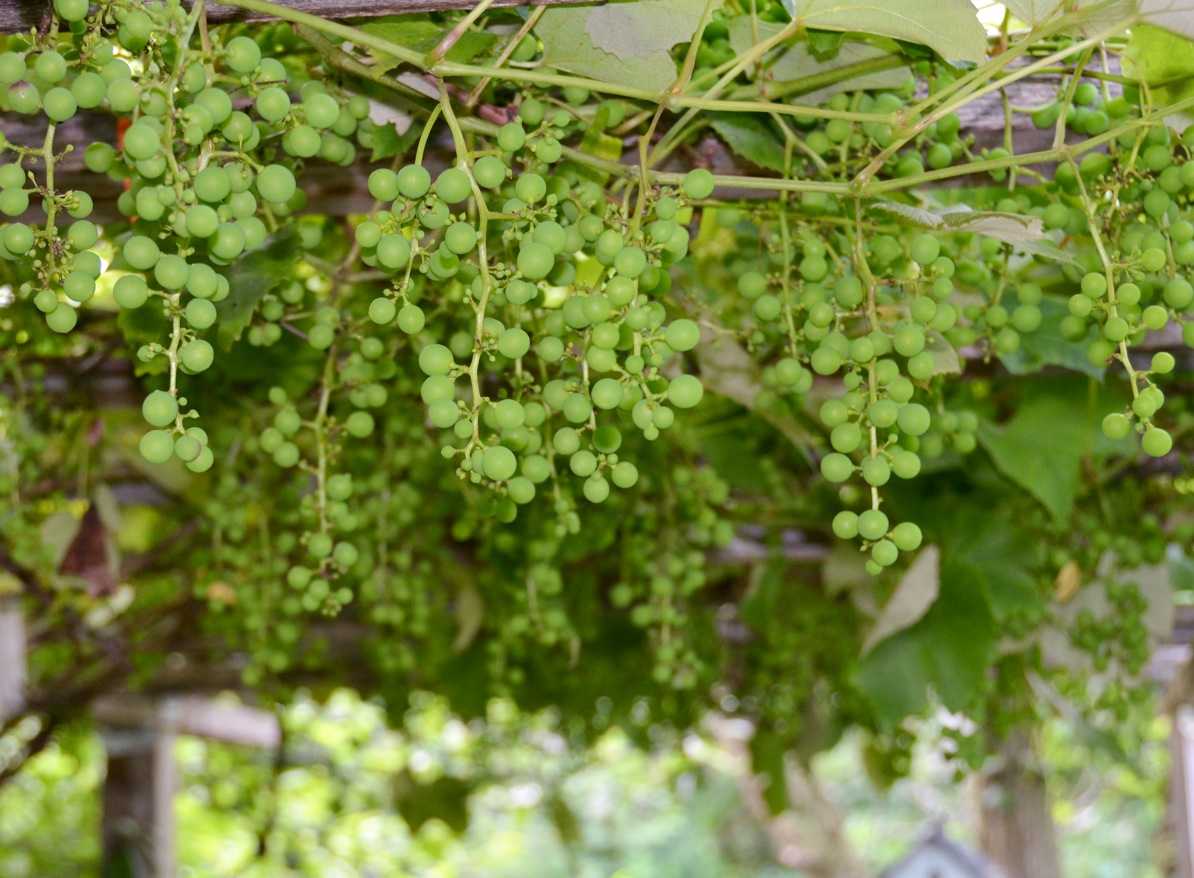
The concord grapes did poorly last year, probably because of the early warm weather followed by freezing temperatures. This year, as shown in the photograph, there are far too many. This is after I pruned out a lot of the canes that had little grape clusters. I still haven't devised a method of pruning grapes and the result is that there is too much fruit. I fear that the plants will not be able to sustain the growth and develop this many clusters but don't know what to do at this point other than let them try. Hopefully there is now enough growth over the arbor that I can effectively prune them next year to provide a sensible amount of fruit. Like the currants and cherries, the grapes, at least in past years, have not been eaten by birds or squirrels.

We also have several gooseberry plants that have a good crop. We haven't picked any yet. Since they are between the compost bin and the fence around the vegetable garden and have thorns harvesting may be difficult.


Tuesday, May 28, 2013

This year's experiment - straw bale gardening.


Periodically I try something new. One idea I came across between the end of last year's garden and the beginning of this year's was planting in straw bales.
It seemed a good way to rotate tomato plants to a spot in the yard that didn't have late blight or whatever it is that annually causes the lower leaves of my tomato plants to wither and drop off.

We had six bales of straw delivered and set them on the driveway. I added a couple of inches of  compost to the top and, a few days later, another couple of inches. When it came time to plant, which I did way early, I used an old rake handle to make a conical hole at appropriate places in the straw and filled them with more compost. (I suspect soil would have been better.) Then I planted a variety of tomato plants, some of which are determinate and some indeterminate. I also planted one patty pan squash.

We had some very warm weather around the beginning of May but no sooner did I plant the tomatoes (and the peppers in the regular garden) than we had a cold spell. With covering - row cover material for the straw bale area and peppers and upside down driveway sealer cans for the tomatoes in the garden - everything survived quite well.

My major concern is where the plants will obtain the nutrients they need to grow. I assume the inside of a straw bale is bereft of nitrogen, potassium and phosphorus and also the fungi that assist plants to obtain nutrients. I have added some fish emulsion and will soon side dress with a mixture of bone meal, blood meal and green sand.

This is an experiment. We have enough squash and tomato plants in the rest of the garden that should this fail we will not be at a loss. So far these plants do not show any differences compared to those in the soil.

Thursday, August 16, 2012

One Thing Leads to Another

I've noticed this year how things are connected. In March we had some very warm weather that caused the fruit trees to bloom early. Then in April there were a couple of heavy frost days. One result is that there will be a much smaller crop of apples and some other fruits. That, in a chain of events in our yard, led to the partially eaten tomato in the photo.

What's the connection? The damage to the tomato came from a squirrel. I have even seen one trying to carry one of these nearly one pound Hungarian Heart tomato up our wooden fence. It was too much weight.

In the past squirrels have not bothered our tomatoes although I know that other people have had squirrel gnawed tomatoes. The reason we escaped was that we have a pear tree and an apple tree in our garden area. The squirrels strip both trees of their fruit during the season and apparently have had enough to satisfy their needs. We would often see them scampering along the fence or across the roof of the house with an apple or pear held securely in their teeth.

But this year we had no pears and no apples. We still had squirrels and they needed food. They ate the green berries on the pagoda dogwood trees, which meant that the birds who usually eat the dogwood berries when they are a little riper had to find something else. One of those something elses was our blueberries. But the pagoda dogwood berries were not enough for the squirrels. They were also into the raspberries. And, recently, the tomatoes. So that warm weather in March resulted in far fewer blueberries and early raspberries for us and fewer tomatoes. And I think they have their eye on the grapes.

I don't find squirrels quite as cute as I used to. But perhaps that is because they look a little gaunt this year.

Friday, July 27, 2012

Every year is different

The challenges each year change. Two years ago a major problem was slugs and snails. I have hardly seen any this year, perhaps due to the very dry weather.

The dry weather brings its own challenges and they are varied, with one thing leading to another. A major factor this year has been the early warm weather followed by a normal frost, the result of which was that both the pear tree and the apple tree had no fruit. This would not be a concern since we eat very few of the pears and none of the apples. However, the pears and then the apples are a major source of food to the squirrels that visit our yard. In the absence of the fruit the squirrels have moved on to other sources of food. In the food garden they went after the early raspberries (and probably will go after the later raspberries since it is probably fruitless to try to protect them). They have eaten the unripe pagoda dogwood berries, which would have become a major source of food for the robins and catbirds. I fear that as the Concord grapes ripen the squirrels will eat those. We are planning to put paper bags around some of the larger bunches in an attempt to protect them. So far I haven't seen any damage to tomatoes, which are beginning to ripen.

The dry weather has affected the productivity of the garden. Rain always seems to be in the near forecast but with few exceptions has avoided our gardens this year. On the Doppler radar screens we can see rain passing to the north or the south or sliding past diagonally in such a way that we are missed. But with the forecast of rain I have put off properly watering the vegetable garden in the hopes that it won't be necessary. The major effect that I have noticed has been on the blueberries and eggplants. The blueberries were small and some were wrinkled. We harvested very few berries. Even though I erected our deer fencing over the blueberry area we were frequently releasing catbirds (and the occasional robin) from the area. I never discovered how they got in. Chickadees also ate blueberries, perhaps more than the other birds combined. Chickadees would just fly over and land on the netting, go through the spaces, and fly to the plants and eat what they wanted. Next year I will have to replace the deer netting with bird netting and figure out how to tie it together without places for the birds to enter.