Saturday, August 27, 2011

Grape Progress, or, not the Grapes of Wrath


We planted two Concord grape vines two years ago. I have been bumbling along not sure how to take care of them - when to prune, what to prune, how much to prune, when to let the bunches grow, how many to let grow. This spring I built an arbor for them to grow on but the top of the arbor was a little higher than the wire on which they had been growing, so none of the bunches of grapes are hanging down from the arbor. They are, instead, hanging from last year's vines that were attached to the wires. I pulled the wire up closer to the top of the arbor and the new growth is mostly up there.

The vines produced lots of little bunches of grapes and I was pretty sure that there were far more than the two plants could sustain. I had read that I should let a small number of bunches grow this third year. I removed those that looked particularly sparse but I let most of them keep growing. They did, although only about half of the grapes in many bunches actually filled out. They started turning purple a while ago and when I walked under the trellis several days ago, I could smell grapes.
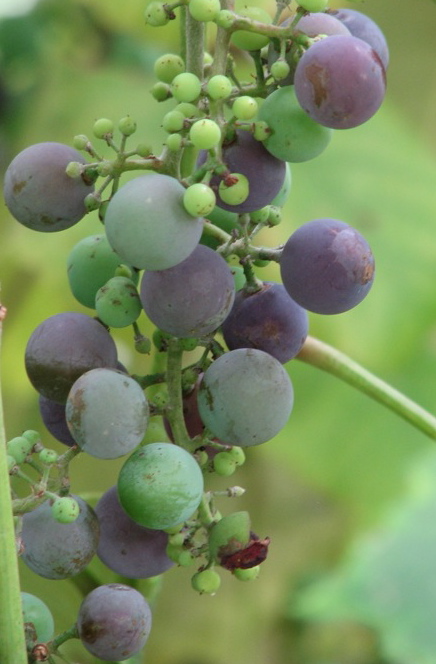
Since I have been making jam this week - peach, pear (more about that in a later post) and blackberry - I decided to see if I could collect enough grapes to make grape jam. Th
e recipe calls for 5 pounds of grapes (including stems). I began picking those individual grapes that looked ripe (nice dark purple color - none in this photo have reached that color) instead of picking them by the bunch. That would have sacrificed a lot of unripe grapes. I had a little over two pounds when I weighed the first picking. So I picked some more and then some more, eventually picking all of those I saw that looked ripe and ended up with 4.91 pounds. This turned out to be a little more than I needed so I will amend the recipe to call for 4+ pounds of actual grapes instead of 5 pounds of grapes including stems.

When the jam was finished there was a small amount that didn't fit into the seven 12 ounce jars. When it cooled a taste test showed that it actually was grape jam. So, despite my misgivings and with a lot of room for improvement, we had a successful grape harvest. I think that next year's fruiting canes are mostly up on top of the arbor. I hope that by limiting the number of bunches they will fill out better and look like the Concord grape bunches at the Regional Market. That would also mean bigger grapes. But I am happy with the result this year. And there are still grapes to be picked.

Sunday, August 7, 2011

Potato Harvest and Squash Vine Borer Damage

There are good things and bad things happening in the garden. I harvested my crop of potatoes two days ago and stored most of them in a dark room in the cellar in layers in bushel baskets. I think I could have waited a few more weeks to harvest them. The leaves were beginning to yellow quite a bit but they were not close to being completely dried out. But I was looking for space in the garden to start some more pole beans since the ones planted earlier seem to be in decline. Whether this is from the hot weather and lack of rain or from a groundhog that might have been chewing on their stems I don't know. [The soy beans right next to them are pretty much gone - apparently a groundhog favorite. ] After I finished the harvest I read that one way to harvest potatoes is to cut off the plants and leave the tubers in the soil for a couple of weeks before harvesting them.

I have been looking for evidence of squash vine borers for several weeks. For the past several years the only evidence has been suddenly dying plants with the stems nearly chewed apart. I had never seen the squash vine borer. I noticed two days ago that one of my squash plants clearly had been infected and was finished. I pulled out the plant and then dissected the stem where it was clear something had gotten into it. I saw the first borer, followed, as the dissection proceeded, by eight others. In the photo there are three visible - one trying to crawl out of the picture, another just a little above my finger nail, and the third farther back. Today I checked my two other older squash plants. Both had holes in their stems and borers inside. I did my best to scrape the borers out - I only actually saw one in each stem - and the put the stems back together and covered them with soil. I expect one will not survive because I cut out a fairly large section of that part of the stem and that leaves only a small passageway for water to get to the leaves. The other one may survive, although I don't know how many borers I left inside.
One thing I did note is that the borers entered above the cheesecloth that I had wrapped around the stems when the plants were small. One obvious effort to make next year (and the rest of this year) is to keep wrapping cheese cloth around the stems as they grow. I know that one suggestion often made is to grow the plants under row cover material so that the insect that lays the eggs that become the borers can't reach the plant. But then the material has to be removed when the plant begins to flower and it seems to me that the borers come after that. Fortunately I have three other squash plants started, one of which is already producing. We won't lack for squash. This year we have either had a lot of squash at once, or none. Next year I would like to try starting squash plants at three week intervals to even out the harvest and, hopefully, limit the damage from borers.


Tuesday, July 26, 2011

Dry, Hot Weather


We had a wet April but recently we have been in an extended dry spell, and, more recently, very hot weather. In the past seven days we had four days in a row over 90 degrees, one of which reached 101 degrees. With that heat and no rain (and little moisture in the soil) plants suffer. In my garden the cucumbers and summer squash most dramatically show the effect. By early afternoon on those very hot, dry days they looked like they were dying. Their leaves - both cucumbers and squash have lots of leaves and only root in one place - get seriously wilted. Once the sun goes down they perk up again if I have watered in the past day or two. But fruit growth appears to stop. We recently picked large amounts of squash (nearly 10 pounds one day) and cucumbers (more than 10 pounds one day). But now there are no squash or cucumbers to pick. I assume one plant mechanism when it is hot and there is little moisture available is to stop making the fruit that uses so much water.

If I am correct, when we get rain (if we get rain) and cooler weather the little cucumbers and squash will again form and grow.

I had thought that one of the summer squash plants that had really wilted and tipped over had succumbed to the squash vine borer. But I can't find any evidence of damage to the stem of the plant. No frass. No holes that I can find. So maybe the cheese cloth I wrapped around their young stems did work. Time will tell. I hope that the time for the insects that lay the vine borer has passed because I just planted some more squash and cucumber seeds.

Tuesday, July 19, 2011

My Poor Brassicas and Cabbage Worms


I start many of my vegetables indoors even during the summer. But it seemed wasteful to keep the recent planting under lights in the cellar and so I put them outside in the shade during the day and on the open back porch each night. I began to notice that there was some leaf damage and a few days ago they were looking pretty chewed up as shown in the photo to the right. When I looked at them there was brown "dust" on some of them. Each day the damage was worse. Finally I looked more carefully and noticed the following:

This close the villain becomes clear. See the two parallel cabbage worms on the right most leaf. I found two more worms later that day. The next day I found another four worms.

The source of the cabbage worms is the little cabbage white butterflies that are so common in my garden. I suppose damage to the other brassicas in my garden is from the same source but plants in the garden grow so quickly that the damage is insignificant. And perhaps there are predators (toads and birds) that pick some of them off. The ones on my little seedlings were able to chew away unmolested.

Undeterred I planted all of these miserable looking seedlings in the garden during yesterday's rain. What was in the tray were collards, zen (an Asian green), komatsuna (another Asian green) and dinosaur kale. The komatsuna was the least damaged and the zen the most damaged. I don't know whether that had to do with the chemistry of the plants or simply their proximity to where the eggs were laid.

Next year I will be more observant. The brown "dust" that I observed was the frass (droppings) of the caterpillars (worms). The way I located most of them was by seeing where the frass was and looking carefully in that area.

Monday, June 13, 2011

Full Garden


With the warm weather having arrived the garden is pretty full. Crops like tomatoes and beans are already beginning to take off. Here are pole beans at the base of their trellises. Some are starting to wind around the trellis and begin their climb up.

Tomatoes have begun to shoot up. I tied them for the first time yesterday, while dodging raindrops. For any indeterminate tomatoes (those that
continue to grow seemingly forever) I remove any suckers and tie the plants to stakes, similar to the green stake in this bean photo. For my one determinate tomato I use a wire tomato cage and leave the side shoots.

Everything looks good so far with the exception of spinach. Last year I had a huge crop. By this time I had harvested 13 pounds of spinach to freeze as part of the 55 pounds of produce. This year my total is only 46 pounds and less than a pound is spinach. After I planted it rained heavily for several days and I think some of the soil and seeds were washed away.

One of my favorite crops is kale. I grow both Red Russian kale and a dinosaur kale - pictured here. Our new method of
preparing the kale is to make "kale chips". I remove the large veins of the leaves and then cut them in half. My wife mixes these with olive oil and grated parmesan cheese and bakes them at 375 degrees until they are crispy. For the two of us it takes about a pound of kale, but that is pretty much the whole meal. I prefer the dinosaur kale because the leaves are more compact and make better chips.

Some parts of the garden are beginning to turn over. The crops that were in cold frames are mostly gone. These included mache, claytonia, kale and lettuce. All of them bolted or are beginning to bolt and about all that is left is a little of the lettuce and that will be gone very soon, probably to the compost pile since I have newer lettuce that needs to be used.

The potatoes look healthy and are beginning to flower. Garlic scapes have appeared and need to be harvested. It is also the season for weeds to grow prolifically.

Monday, April 25, 2011

The New Season Begins

Because I had surgery on April 11th I planted as much of the garden as I could before April 9th. Right after that we had two fairly sunny days followed by days of rainy weather. Some of the transplants were scorched but they seem to be slowly getting established.

In the past week we have begun using some of the plants that made it through the winter. We harvested about six pounds of leeks that were left over from last year. The leeks were not protected from the snow in any way. (Similarly there are scallions in the garden that wintered over.) Today I picked some of the lettuce, mache (corn salad) and claytonia for our lunch time salad. We could pick some kale but we still have frozen greens to use up first.

I haven't yet gotten back to gardening, other than transplanting some of the lettuce that we grew in the cellar and harvested during the winter (see the earlier post about Indoor Lettuce). Tomorrow it is supposed to be quite warm (close to eighty degrees) and I would like to plant potatoes.

Friday, March 18, 2011

Yes! Winter is Over


I returned from North Carolina two days ago. There was no snow of note anywhere on the drive back except in our backyard. But now that is gone. As a clear sign of Spring I put up the outdoor clothes line. Even better, the soil temperature was around 60 degrees and the soil was at that desired state of being able to "be worked". I got out my shovel and dug several areas of winter rye. Admittedly it had not grown all that well and so it was very easy to dig it under.

The new season awaits.